Workforce Wednesday
The Moment We’re In Demands More
I recently returned from the National Home Performance Conference in Columbus, Ohio, with a renewed
sense of urgency about the role workforce development has to play in this moment. The conference
brought together leaders from across the country focused on home performance, energy efficiency,
healthy homes, contracting, training, and implementation.¹ As I listened to the conversations taking
place throughout the event, I found myself coming back to the same conclusion: regardless of the sector,
the technology, or the level of investment, none of this work moves forward without a strong and
intentional workforce behind it.
That may sound obvious, but I do not believe we are treating it with the seriousness it deserves.
Across industries, we are seeing continued growth, transformation, and increased pressure to deliver.
Construction, infrastructure, energy, advanced manufacturing, healthcare, transportation, and
information technology are all asking some version of the same question: where will the talent come
from, and how will that talent be prepared to meet the demands of a changing market? In many spaces,
the need is no longer theoretical. It is immediate. Employers need workers. Communities need access to
careers. Industries need people who can step into work with the right technical skills, professionalism,
and long-term potential.
In the energy sector, that challenge is especially visible. The U.S. Department of Energy has made clear
that the transition underway requires more than innovation and capital. It requires a workforce strategy
grounded in job creation, job quality, and job access.² That framing matters because it reinforces
something many of us working in workforce development have known for some time: talent
development is not a side conversation to economic growth. It is one of the central conditions required
for growth to happen at scale.
The labor market data continues to reinforce that point. The U.S. Bureau of Labor Statistics projects
strong demand across several of the occupations most closely tied to the built environment and
technical trades. Employment of electricians is projected to grow 9 percent between 2024 and 2034,
with roughly 81,000 openings each year. HVAC mechanics and installers are projected to grow 8 percent
over the same period, with about 40,100 openings annually. More broadly, installation, maintenance,
and repair occupations are expected to generate hundreds of thousands of openings each year over the
next decade.³ These are not marginal opportunities. They reflect sustained demand for workers who can
support the systems, homes, buildings, and infrastructure our economy depends on.
At the same time, demand alone does not create a functioning workforce ecosystem. That is where I
think the conversation often becomes too shallow. We can point to job growth, sector expansion, and
public investment, but those indicators do not automatically translate into accessible career pathways or
talent pipelines that employers trust. The International Energy Agency recently noted that energy
employment has grown while skills shortages are beginning to threaten future momentum.⁴ That
observation should not be limited to energy alone. It points to a larger challenge facing many industriestoday: opportunity can grow at the same time that workforce systems remain fragmented, inconsistent,
or underdeveloped.
From my perspective, this is where workforce development has to become more intentional and more
honest about what it takes to move someone from interest to opportunity. Too often, we still design
systems that assume people can navigate complexity on their own. We expect individuals entering a field
to understand training options, evaluate credentials, manage transportation or childcare barriers, build
trust with employers, and make major commitments without a clear view of what sits on the other side.
On the employer side, particularly among small and midsize businesses, we still see hesitation rooted in
uncertainty around whether candidates are truly ready, whether training aligns with real business needs,
and whether the workforce pipeline will produce people who can stay and grow.
That is why I believe the issue in front of us is not simply a talent shortage. In many cases, it is a systems
design issue. Brookings recently described part of the labor market challenge as a “conversion problem,”
meaning that too many potential matches between workers and firms fail to become stable employment
relationships.⁵ I think that framing is useful because it pushes us beyond general discussions about
awareness or enrollment and forces us to look more closely at outcomes. Exposure to a career path is
not enough. Enrolling in training is not enough. Even completing a program, by itself, is not enough. The
real question is whether workforce systems are designed to support progression from awareness, to
readiness, to placement, and ultimately to retention and advancement.
That progression matters because workforce development should not be measured only by activity. It
should be measured by whether people are actually moving into jobs with real opportunity and whether
employers are gaining access to talent that can help them perform and grow. If that is the standard, then
we need to think differently about what strong workforce development requires.
It requires deeper employer engagement earlier in the process, not after programs are already built. It
requires training that is tied to actual skill expectations and labor market value. It requires support
services to be treated as part of workforce strategy rather than as optional add-ons. It requires stronger
coordination between training providers, community-based organizations, employers, public systems,
and industry intermediaries. Most importantly, it requires us to stop treating workforce development as
a secondary response to market demand and start treating it as essential infrastructure.
That need is showing up in national policy and funding decisions as well. The U.S. Department of Labor
has continued to invest in apprenticeship and pre-apprenticeship pathways, including recent YouthBuild
funding to support occupational skills training and workforce entry for young people, as well as efforts to
reduce barriers to scaling Registered Apprenticeship programs.⁶ These are important moves because
they reflect a growing recognition that talent pipelines do not build themselves. They require structure,
investment, coordination, and long-term commitment.
What I took away from Columbus is that many sectors are feeling this pressure at the same time. There is
real momentum in the market. There is growing recognition that workforce matters. There are more
conversations taking place about access, job quality, pathways, and retention than there were even a few
years ago. All of that is positive. But recognition is only the starting point. The moment we are in requiresmore than acknowledgment. It requires discipline in how we design pathways, urgency in how we build
partnerships, and clarity in how we define success.
For those of us working in workforce development, that means keeping the conversation focused on
what will actually strengthen talent pipelines over time. It means pushing beyond high-level language
and asking harder questions about whether systems are accessible, whether training leads to real
opportunity, whether employers are truly engaged, and whether the people we say we want to reach
can see a future for themselves in the work.
That, to me, is the real challenge in front of us. The issue is not whether workforce development matters.
It clearly does. The issue is whether we are willing to treat it with the level of strategy, coordination, and
investment required to meet the demands of this moment.
Because if this moment has made anything clear, it is that the future of our industries will depend in
large part on whether we are serious about building the talent needed to sustain them.
Market Signals & References
- Building Performance Association. 2026 National Home Performance Conference & Trade Show.
- U.S. Department of Energy. Energy Workforce Development Initiatives.
- U.S. Bureau of Labor Statistics. Occupational Outlook: Electricians; HVAC Mechanics and Installers.
- International Energy Agency. Energy employment has surged, but growing skills shortages threaten future momentum.
- Brookings Institution. Missing jobs are a conversion problem.
- U.S. Department of Labor. YouthBuild and Registered Apprenticeship expansion initiatives.
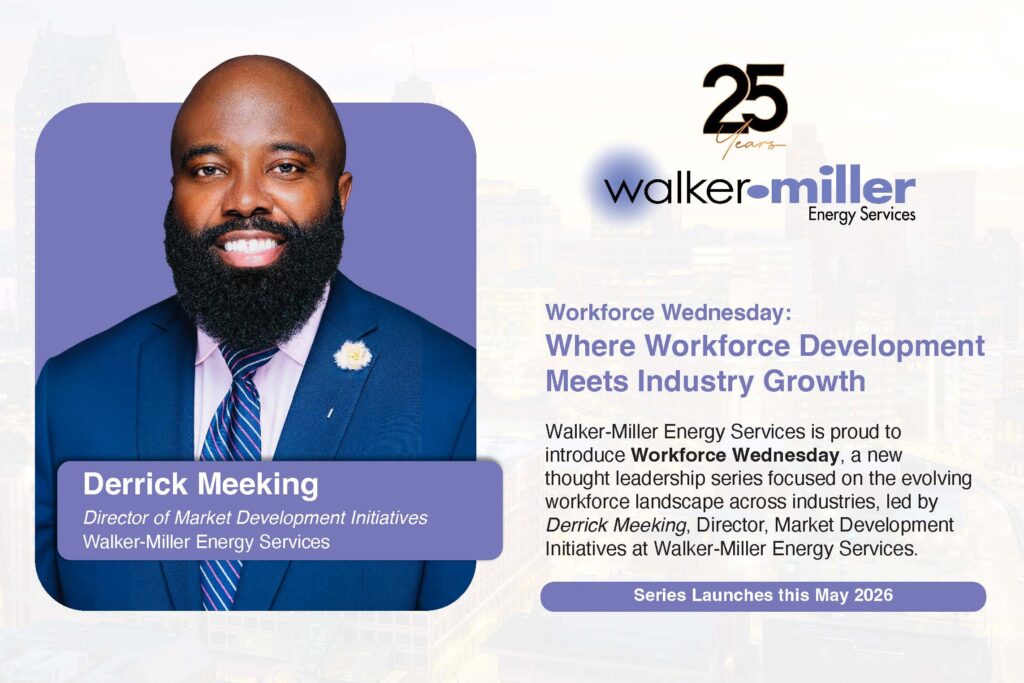
Derrick Meeking is Director of Market Development Initiatives at Walker – Miller Energy Services.
Workforce Wednesday is a recurring column reflecting on workforce development, industry trends, and
the evolving talent needs across sectors