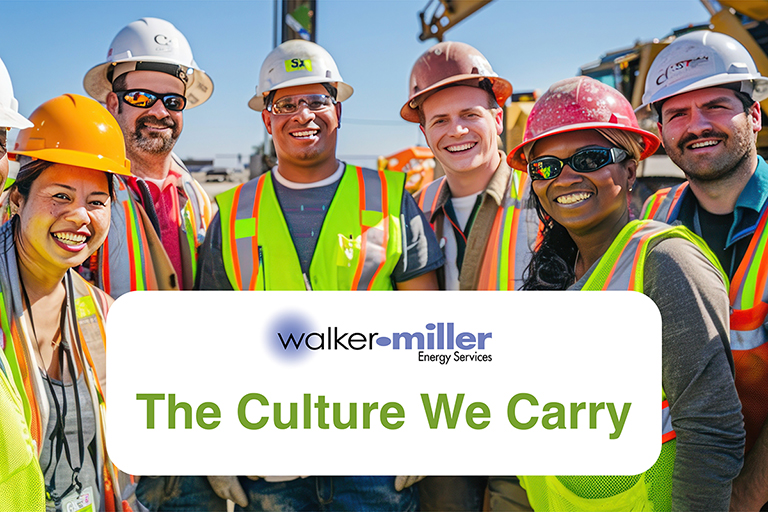
 Workforce Wednesday: The Culture We Carry
The longer I study organizations, the less I believe culture is something we build. I think it’s something we inherit from one another every day.
For a long time, I thought culture was primarily the result of vision, values, and leadership. Those things matter. They establish direction, define expectations, and provide organizations with a shared sense of purpose. But after years of working alongside employers, contractors, educators, community organizations, public agencies, utilities, and leaders across different industries, my thinking has changed. I no longer believe people experience an organization the way it describes itself. I think they experience it through the people they encounter every day. That may seem like a subtle distinction, but I have come to believe it changes everything.
One observation has stayed with me throughout my career. People rarely compare organizations by their mission statements. They compare them by how people made them feel while they were there. They remember the supervisor who believed in them before they believed in themselves. They remember the teammate who answered questions without making them feel inadequate. They remember the leader who created space for ideas instead of simply asking for them. Unfortunately, they also remember the environments where speaking up felt risky, mistakes were remembered longer than accomplishments, or potential had to be repeatedly proven before it was trusted. What stays with people is rarely the policy—it is the experience.
The more I’ve reflected on that reality, the more I’ve started noticing something else. People don’t leave organizations empty-handed. They leave carrying the environment they experienced there. Someone who has spent years in a culture built on trust often extends that trust naturally when they join a new team. Someone who has learned that mistakes are met with embarrassment rather than coaching may carry that hesitation into future opportunities without even realizing it. Encouragement, accountability, curiosity, confidence, and even fear have a way of traveling with us. We don’t simply move between organizations; we carry pieces of those environments into every place we go next.
I’ve watched that happen across industries and communities for years. A contractor mentors an apprentice using the same patience that someone once extended to them. A new manager adopts habits they learned from a supervisor years earlier. A teacher creates a classroom that reflects the encouragement they once received—or perhaps the encouragement they wish they had received themselves. None of those people are intentionally preserving culture. They’re simply passing forward experiences that quietly shaped them. That’s what has caused me to rethink culture altogether. Perhaps culture isn’t something organizations possess. Perhaps it moves through people.
Policies establish expectations, but people establish experiences. Strategy gives an organization direction, but everyday interactions determine whether people trust that direction enough to follow it. We often talk about organizational culture as though it belongs to the organization itself. Increasingly, I wonder if culture actually belongs to the people who carry it from one experience to the next.
The longer I’ve worked across organizations, the more I’ve realized that people don’t compare organizations by their mission. They compare them by how people made them feel while they were there. I’ve walked into organizations with extraordinary mission statements and ordinary cultures. I’ve also walked into organizations with simple mission statements and extraordinary cultures. The difference has rarely been the words on the wall. It has almost always been the people others encountered when they walked through the door. That observation has stayed with me because it reminds me that culture is rarely experienced as an organizational concept; it’s experienced as a human one.
Research increasingly supports what many practitioners have quietly observed over the years. Gallup has consistently found that managers account for approximately 70 percent of the variance in employee engagement, demonstrating how profoundly everyday relationships shape people’s experience at work.¹ Amy Edmondson’s research on psychological safety has shown that environments built on trust encourage learning, innovation, and healthy risk-taking.² MIT Sloan Management Review has likewise observed that culture spreads through consistent daily behaviors far more than formal statements of values.³ The Edelman Trust Barometer continues to demonstrate that trust is built person to person long before it is attributed to institutions.⁴ Viewed together, these are more than workplace trends. They point toward a much larger truth: people learn what to expect from organizations by first learning what to expect from one another.
The more I reflect on this, the more I believe every one of us becomes part of someone else’s story about work. Whether we’re welcoming a new employee, coaching a colleague, leading a meeting, teaching a class, serving a customer, or simply working alongside someone trying to find their footing, we’re shaping an experience that may extend far beyond the moment itself. Most of us will never know where those experiences ultimately travel. We won’t see every conversation echoed years later in another organization, another team, or another generation of leaders, but they travel nonetheless.
Perhaps that’s why I no longer think the most enduring part of culture is written in mission statements or displayed on office walls. I think it lives in people. Every interaction leaves something behind. Every conversation quietly shapes what someone else comes to expect from work, leadership, trust, and possibility. We may never know the full reach of those moments, but someone will carry them into the next meeting, the next team, the next organization, and eventually into the lives of people they influence themselves. Perhaps that’s the quiet responsibility we all share. Culture isn’t simply something we create; it’s something we carry. Every day, whether we recognize it or not, we hand a small piece of it to someone else.
Market Signals & References
¹ Gallup. State of the Global Workplace: 2025 Report. Gallup, 2025. https://www.gallup.com/workplace/
² Edmondson, Amy C. The Fearless Organization: Creating Psychological Safety in the Workplace for Learning, Innovation, and Growth. John Wiley & Sons, 2019.
³ MIT Sloan Management Review. Organizational Culture Collection. Massachusetts Institute of Technology, MIT Sloan School of Management. https://mitsmr.com
⁴ Edelman. 2026 Edelman Trust Barometer: Trust and the Crisis of Grievance. Edelman, 2026. https://www.edelman.com/trust