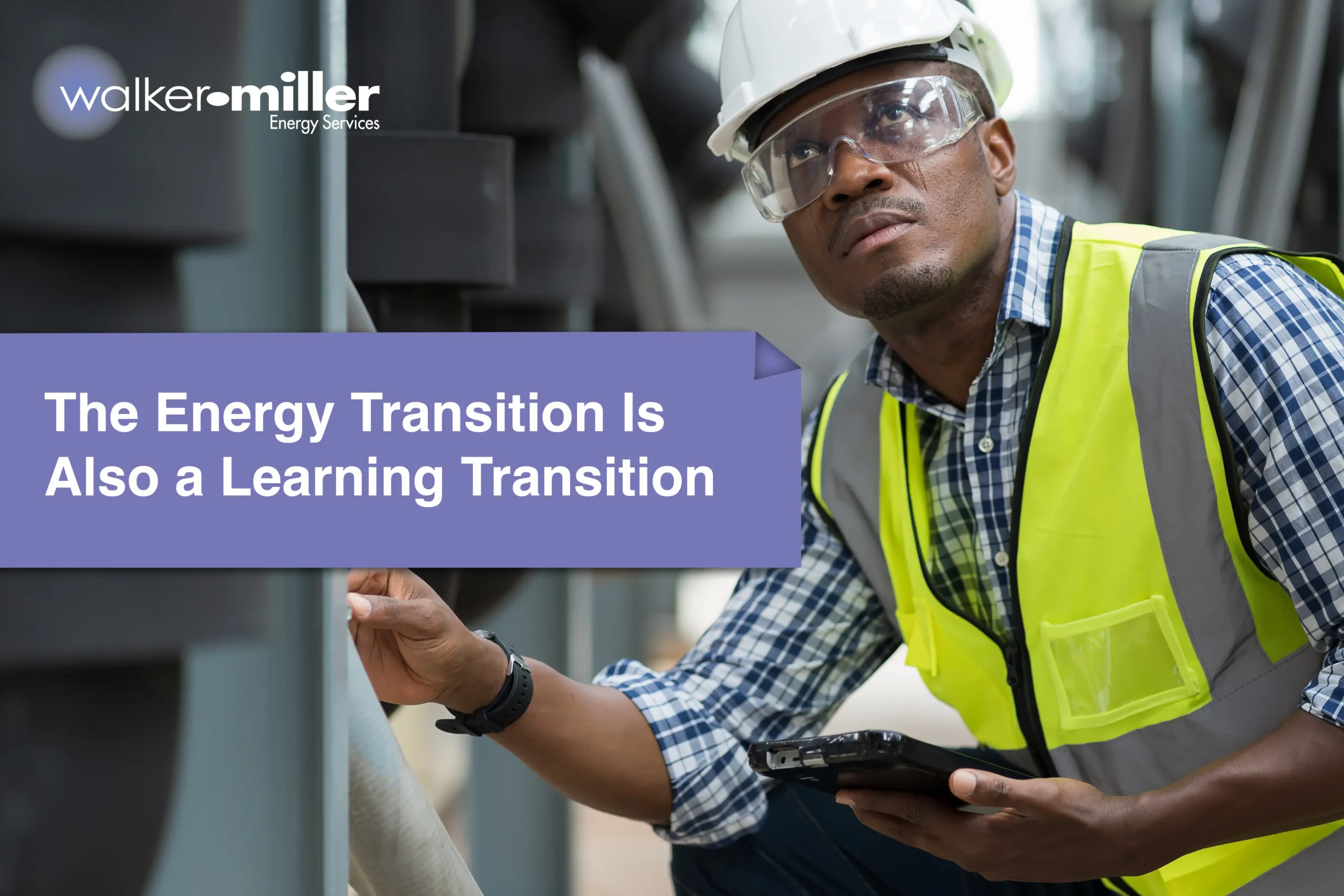
 The Energy Transition Is Also a Learning Transition
One of the assumptions we carry about work is that learning happens before the job begins. We go to school, complete training, earn a credential, develop a skill, and then enter the workforce prepared to apply what we know. The longer I have worked around workforce development and the energy sector, the less convinced I am that assumption still holds. In many careers, and especially across a changing energy economy, learning is no longer something that simply prepares us for the work. Increasingly, learning is becoming part of the work itself.
We spend a great deal of time discussing the workers the clean energy transition will require, and understandably so. New technologies, infrastructure investments, and emerging occupations are creating demand for people with the skills to support them. But many of the people who will carry this transition forward are already working. They are technicians, contractors, instructors, engineers, project managers, business owners, students, and professionals whose jobs may look different several years from now than they do today. For them, the transition is not necessarily about leaving one career and starting another. Often, it is about continuing to grow inside the career they already have.
The International Energy Agency has documented how demand for occupations, qualifications, and skills is changing across renewable energy and energy efficiency, including the need for both traditional and emerging technical capabilities.¹ That changes the way we should think about readiness. Preparing someone for today’s job is important, but it may no longer be enough to assume that the knowledge required on day one will carry someone through an entire career. Equipment changes, codes and standards evolve, technology becomes more connected, and roles that once existed largely within one discipline increasingly intersect with others.
None of this means the experience people have already earned is becoming less valuable. I believe the opposite is true. Experience gives people judgment, context, instincts, and an understanding of the work that cannot always be captured in a textbook or certification exam. A seasoned technician may recognize a problem before a newer worker understands why it is a problem. An experienced instructor can often tell when a learner is struggling before an assessment shows it. A business owner who has spent years serving customers understands relationships and trust in ways that cannot simply be replaced by learning a new technology.
The opportunity is to build new knowledge on top of that experience. That is different from constantly telling people they need to retrain or start over. I do not believe the future of work requires people to repeatedly discard what they know. I do believe it will require more of us to become comfortable adding to what we know, questioning something we may have done the same way for years, and occasionally becoming a beginner again.
That part of the conversation is more human than technical. Learning something new early in a career is expected. Learning something new when you are already considered experienced can feel very different. There is a certain comfort that comes with knowing your craft, being the person others come to for answers, and trusting the expertise you have built over time. Then a new technology, process, standard, or expectation arrives and suddenly there are questions you cannot answer yet. That moment can be uncomfortable, but it does not erase expertise. In many cases, it is where expertise begins to evolve.
The World Economic Forum estimates that 39 percent of workers’ existing skill sets could be transformed or become outdated between 2025 and 2030, while curiosity and lifelong learning are among the capabilities expected to become increasingly important.² I am careful with statistics like that because they can make the future of work sound as though everything people know today is quickly becoming irrelevant. I do not believe that is the right interpretation. More often, change happens within the work itself. A role expands, a tool changes, an experienced worker adds a new competency, or someone who has spent years mastering one technology learns how it connects to another.
For students and people just entering the workforce, there may actually be something freeing in that. We put tremendous pressure on people to choose the right major, credential, trade, or first job as though one decision will determine everything that follows. Careers rarely unfold that neatly. A strong foundation matters, but so does the ability to continue building on it. The ability to ask a good question, accept feedback, solve an unfamiliar problem, and remain curious can travel with someone long after a specific technology or job description changes.
Employers and workforce organizations also have a responsibility in this conversation. We cannot tell people they need to become lifelong learners while continuing to treat training as something that ends once they are hired. The International Energy Agency has reported that energy employers facing skilled worker shortages are increasingly recruiting from neighboring industries and investing in training within their own organizations.³ If the work continues to change, opportunities to learn have to exist inside the workplace as well as before someone enters it. That can mean mentorship, upskilling, new credentials, stronger partnerships between employers and educators, or simply creating an environment where someone can say, “I haven’t learned that yet,” without believing those words diminish everything they already know.
Adaptability is often described as a workforce competency, but in practice it requires more than technical ability. It requires confidence, humility, curiosity, and an environment where learning is treated as professional growth rather than evidence that someone has fallen behind. That may be especially important as we think about the people who already have years of knowledge and experience. The goal should not be to make experience compete with new learning. The goal should be to create space for the two to strengthen one another.
The energy transition will require more workers, stronger technical pathways, and continued investment in education and training. Those needs are real, but I think there is another part of the conversation that deserves just as much attention. We are not simply preparing people to enter an industry. We are asking people at every stage of their careers to remain capable of growing as that industry changes around them. That includes the student entering a first classroom, the technician with twenty years of experience, the contractor learning a new technology, the instructor updating a lesson, and the leader realizing that yesterday’s expertise may not answer tomorrow’s question.
We often think expertise means reaching a point where fewer questions need to be asked. Perhaps the future of work asks something different of us. Expertise may increasingly mean knowing enough to recognize when it is time to learn again. The people best prepared for what comes next may not be the people who know everything about what exists today, but the people who have learned how to remain curious, capable, and willing to grow when what they know is no longer enough.
Market Signals & References
¹ International Energy Agency. Ensuring a Skilled Renewable Energy and Energy Efficiency Workforce. International Energy Agency, 30 June 2026. https://www.iea.org/reports/ensuring-a-skilled-renewable-energy-and-energy-efficiency-workforce
² World Economic Forum. The Future of Jobs Report 2025. World Economic Forum, 7 Jan. 2025. https://www.weforum.org/publications/the-future-of-jobs-report-2025/
³ International Energy Agency. World Energy Employment 2025. International Energy Agency, 5 Dec. 2025. https://www.iea.org/reports/world-energy-employment-2025