Workforce Wednesday: Workforce Development Cannot Be Built from the Sidelines
There is a part of this work that rarely receives the same level of attention as funding announcements, labor market reports, credentials, or hiring projections, yet in many cases it determines whether opportunity actually connects with people in a meaningful way. It is the work of translation. Not translation simply in the language sense, but the work of helping people understand opportunity in a way that feels practical, believable, and connected to their own lives.
Across this field, we often talk about jobs, industries, pathways, and employer demand as though opportunity naturally speaks for itself. In reality, most people are not evaluating career decisions through the lens of economic forecasts or workforce reports. They are trying to determine whether the opportunity being presented feels trustworthy, whether it aligns with their circumstances, and whether the people presenting it actually understand the risks involved in taking the next step.
That reality becomes especially clear when working with young adults, career changers, small business owners, or communities that may not have longstanding exposure to certain industries. Someone considering technical training may be weighing childcare responsibilities, transportation barriers, income stability, or uncertainty about whether the opportunity actually leads somewhere meaningful. A contractor may be trying to determine whether stepping away from daily operations to pursue training or certification is worth the disruption. In both cases, the decision often comes down to whether someone they trust has helped make the opportunity feel realistic.
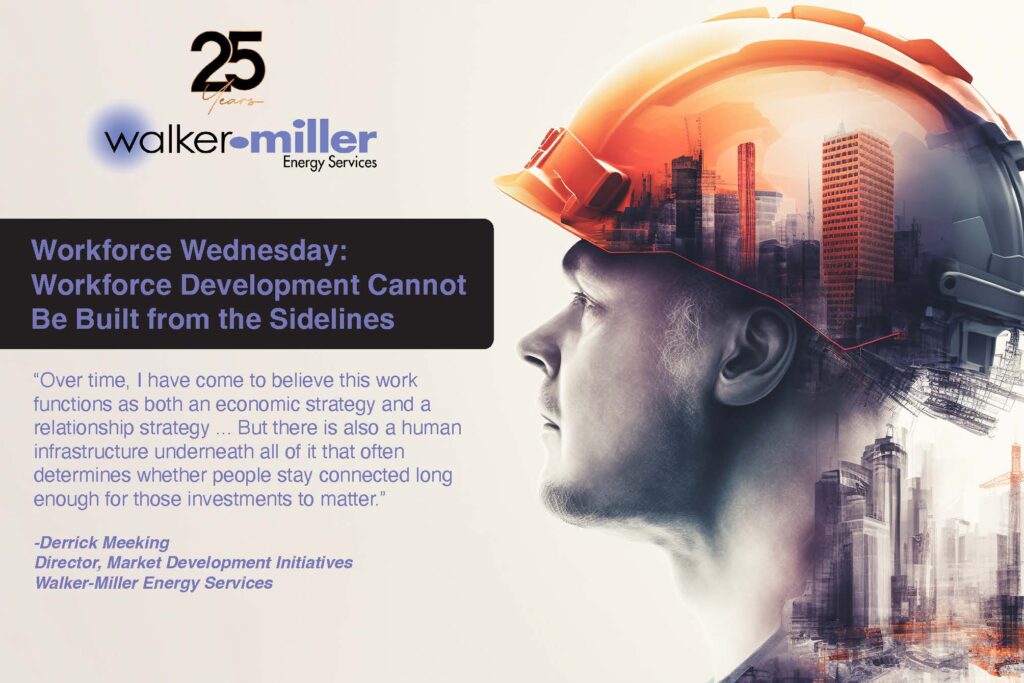
Over time, I have come to believe this work functions as both an economic strategy and a relationship strategy. The technical components matter. Training matters. Employer engagement matters. Funding matters. But there is also a human infrastructure underneath all of it that often determines whether people stay connected long enough for those investments to matter.
Some of the most important conversations I have had over the years never happened during formal presentations or strategy meetings. They happened after class ended. During follow-up calls. In side conversations where someone was trying to decide whether taking a chance on themselves actually felt realistic. Sometimes the hesitation had very little to do with the training itself. It had more to do with uncertainty. Whether the opportunity was stable. Whether the pathway made sense. Whether they could realistically balance life responsibilities while trying to move into something new.
Those moments do not always show up in reports or dashboards, but they shape outcomes every day.
I have also seen situations where a strategy looked strong in a meeting, only for the disconnects to become obvious once implementation started. The language was too broad. Expectations were unclear. Participants did not fully understand what they were committing to. Employers assumed knowledge that had never actually been explained. The people closest to the work could often identify those gaps immediately because they were hearing the questions, frustrations, and uncertainty long before leadership ever saw it reflected in performance numbers.
That insight matters more than we sometimes acknowledge.
The people working closest to participants, contractors, and communities are often carrying a level of practical knowledge that never fully shows up in formal strategy conversations. Trainers know when someone understands the material but lacks confidence. Program managers can usually tell the difference between someone losing interest and someone struggling silently with financial pressure, transportation, or family responsibilities. Community organizations recognize when messaging feels disconnected from the realities people are navigating every day. Employer-facing teams understand how quickly a business can become overwhelmed trying to balance operations with workforce participation.
Individually, those observations may sound small. Collectively, they often determine whether someone stays connected to opportunity or quietly disengages from it.
I see this regularly in conversations connected to energy efficiency, contractor development, and technical training. A participant may initially view building performance or energy efficiency work as unfamiliar or overly technical until someone takes the time to explain how the industry connects to housing quality, affordability, health, resilience, or long-term career growth. A contractor may hesitate to engage with training until another contractor explains how participation helped them better navigate utility programs or strengthen day-to-day business operations. In many situations, the challenge is not the absence of opportunity. The challenge is whether someone has helped make the opportunity understandable enough to trust.
That kind of work requires proximity. It requires people who understand both the systems and the realities of the communities or businesses being asked to engage with them. Jobs for the Future has written extensively about the role social capital and trusted networks play in economic mobility, particularly for young adults navigating education and career pathways.¹ That perspective resonates because it reflects something many practitioners see firsthand. People are far more likely to stay engaged when they feel supported by individuals who can answer questions honestly, explain expectations clearly, and provide context beyond formal program materials.
I do not think this field talks enough about how difficult it is to scale trust. Programs can scale relatively quickly. Funding can scale. Recruitment efforts can scale. Trust develops differently. It is built through consistency, relationships, credibility, and repeated interactions over time. Once trust breaks down, even strong opportunities become harder for people to navigate confidently.
At Walker-Miller, much of this understanding has been shaped through direct work happening across communities, contractor networks, technical training environments, and employer partnerships. Whether supporting participants entering energy efficiency training, helping contractors better understand opportunities connected to the evolving energy landscape, or working alongside community organizations helping residents navigate unfamiliar systems, one thing becomes clear very quickly: technical training alone rarely carries outcomes by itself. People also need context, reassurance, honest communication, and a clearer understanding of where they fit within industries that may feel unfamiliar at first.
This is one reason I continue to believe these conversations have to stay grounded in place and proximity. National conversations around labor participation, economic mobility, and workforce readiness are important, but decisions about opportunity are still being made locally. They are being shaped in classrooms, training labs, contractor offices, community centers, union halls, and conversations between people trying to determine whether taking a risk on themselves is worth it.
The National Fund for Workforce Solutions has emphasized the importance of building community-centered workforce ecosystems where employers, educators, workforce organizations, and local institutions collaborate to support both economic mobility and regional workforce needs.² What stands out in that approach is the recognition that long-term workforce participation is sustained through networks of relationships, not simply through isolated programs or short-term initiatives.
As industries continue evolving, that relational aspect of this work will likely become even more important. Technical sectors connected to energy, infrastructure, manufacturing, and construction are changing rapidly, often faster than public understanding of those industries changes alongside them. Many careers now require a blend of technical skill, adaptability, communication, customer engagement, and continuous learning that people outside the industry may not fully recognize. Bridging that gap requires more than outreach campaigns or recruitment messaging. It requires people capable of helping others interpret where opportunity exists and how to realistically move toward it.
That is one of the reasons I continue to value spaces like the Michigan Energy Workforce Development Consortium’s Annual Summit.³ Convenings like MEWDC matter because they bring practitioners, educators, employers, utilities, and community leaders into the same conversation around shared workforce challenges. But the long-term value of those conversations depends heavily on whether systems continue listening to the people closest to implementation and participant experience, not only the people shaping strategy from a distance.
At its best, this work has never been only about training people for jobs. It has always involved helping people understand industries, navigate systems, build confidence, and recognize possibilities that may not have previously felt accessible to them. That process rarely happens through information alone. It happens through people willing to stay close enough to the work to help others move through it with clarity and trust.
In my opinion, those people are not operating on the sidelines. In many ways, they are helping hold the entire system together.
Market Signals & References
¹ Jobs for the Future (JFF). Social Capital and Economic Mobility.
https://www.jff.org/what-we-do/impact-stories/social-capital/
² National Fund for Workforce Solutions. Building Equitable Workforce Ecosystems.
https://nationalfund.org/our-solutions/equitable-workforce-ecosystems/
³ Michigan Energy Workforce Development Consortium. MEWDC 2026 Annual Summit: Powering Michigan’s Future Energy Workforce.
https://www.careersinenergymichigan.com/events/mewdc-2026-annual-summit/